Showing posts with label pictures. Show all posts
Showing posts with label pictures. Show all posts
Monday, September 9, 2013
HUSABERG FC 450 2005 specifications pictures
HUSABERG FC 450 (2005) Motorcycle Pictures, Preview and Specifications.
High resolution pictutres, available for free download, size 1600 x 1200 pixels
High resolution pictutres, available for free download, size 1600 x 1200 pixels
- Category: Cross / motocross -
Motorcycle Pictures, choose by BRANDS>
HUSABERG pictures, choose by Models >
HUSABERG FC 450 (2005)
Click Thumbnail to download (size 1600 x 1200 pixels)

General information
Model: Husaberg FC 450
Year: 2005
Category: Cross / motocross
Rating: 68 out of 100.
Engine and transmission
Displacement: 449.25 ccm (27.41 cubic inches)
Engine type: Single cylinder
Stroke: 4
Compression: 12.7:1
Bore x stroke: 100.0 x 57.2 mm (3.9 x 2.3 inches)
Fuel system: Carburettor. Keihin MX FCR 41 mm
Valves per cylinder: 4
Fuel control: OHC
Ignition: Digital
Starter: Kick
Lubrication system: Pressure circulation, trochoit oil pump
Cooling system: Liquid
Gearbox: 6-speed
Transmission typefinal drive: Chain
Clutch: Wet multi-disc clutch, hydraulic.
Physical measures
Dry weight: 103.0 kg (227.1 pounds)
Overall height: 1,120 mm (44.1 inches)
Overall length: 2,170 mm (85.4 inches)
Overall width: 810 mm (31.9 inches)
Ground clearance: 380 mm (15.0 inches)
Wheelbase: 1,490 mm (58.7 inches)
Chassis and dimensions
Frame type: CrMo
Front suspension: WP MXMA 4860-Husaberg Motocross
Front suspension travel: 295 mm (11.6 inches)
Rear suspension: WP PDS 5018-Husaberg Motocross
Rear suspension travel: 320 mm (12.6 inches)
Front tyre dimensions: 80/100-21
Rear tyre dimensions: 110/100-19
Front brakes: Single disc
Front brakes diameter: 260 mm (10.2 inches)
Rear brakes: Single disc
Rear brakes diameter: 220 mm (8.7 inches)
Other specifications
Fuel capacity: 9.00 litres (2.38 gallons)
Color options: Yellow/blue
Motorcycle Insurance Info Who will provide physical damage insurance coverage for custom built motorcycles? Nationwide - Custom parts and equipment coverage (up to $30,000), Custom and limited edition bikes and trikes coverage (up to $50,000), Kit and vintage bike coverage (up to $30,000) (nationwide.com/motorcycle-insurance-coverage.jsp) Safeco insures a full spectrum of motorcycles from street cycles, Harley Davidsons, cruisers and touring bikes to dirt bikes and ATVs. If you select custom parts coverage, you will receive up to $3,000 in coverage without any additional cost to you. Coverage is available for up to $10,000 in custom parts and equipment. (safeco.com/personal/motorcycle/coverage-options) Progressive - Motorcycle coverage - when you purchase Comprehensive or Collision coverage, at least $1,000 of Custom Parts and Equipment (CPE)/Accessory coverage - Custom paint, custom plating or custom exhaust is included in most states. Additional CPE coverage can be purchased to cover equipment, up to $30,000 in value. U.S. Car Insurance Companies > |

Saturday, September 7, 2013
2012 Ducati 848 White Review Pictures

Ducati’s middleweight superbike gets a significant upgrade for 2011, further separating itself from the confines of established sportbike categories.
It’s already 17 years since the first small-bore Ducati 4-valve superbike, the 748, broke cover – the same year as the iconic 916, in 1994. The 748 played a background second fiddle to the beloved 916 series until the 749 emerged in 2003. A close relation to the aesthetically challenged 999, the 749 continued to be a relatively low-cost entre into Ducati’s superbike family and competed against the Japanese 600s in supersport competition.
Then MY2008 saw a paradigm shift for the sub-liter Ducati superbikes, with the new 848 getting 15 extra horses and a weight loss of nearly 50 lbs! However, its 101cc displacement bump (to 849cc) made it ineligible for supersport competition, leaving it adrift in a class of its own.

2012 Ducati 848 White


Well, Ducati has upped the ante again with the 848 EVO, bringing along extra horsepower, improved brakes and fitment of a standard steering damper – all for the same price as last year’s 848s.
To demonstrate the EVO’s newfound prowess, Ducati invited us to the historic Autodromo Enzo e Dino Ferrari in the town of Imola, Italy.
It’s within the engine that most of the EVO’s updates are found. The 848’s powerplant remains structurally unchanged, but a multitude of revisions to improve performance creates what Ducati says is “the highest power-per-liter of any twin-cylinder engine in production.”
At the intake side, the fuel-injection’s throttle body size jumps from 56mm to 60mm and feeds fuel into optimized intake ports. New cams offer increased valve lift on both the intake and exhaust sides. A revised combustion chamber and new pistons bump the compression ratio from 12.1 to a high 13.2:1. The 90-degree V-Twin’s rev ceiling has been lifted 500 revs to 11,300 rpm, and heat generated from the extra revs is dissipated by new ventilated timing belt covers.


Aside from new paint color options, the 848 is stylistically unchanged in its EVO guise. For many bikes, this would be a problem. For the 848, its status-quo stance keeps it among the belles of the ball, especially in the new Arctic White Silk seen in these photos, a tasty matte-white pearl with red frame and wheels. Bella!
Our time aboard the EVO at Imola reaffirmed the 848’s sporting credentials, nicely upgraded for 2011 with tweaks that will help it get around a racetrack even quicker than before. It’s an upper-echelon sporting tool that can dust off a Ducati 999 if need be – or nearly anything else on a medium-speed racetrack.
Perhaps it doesn’t matter if the 848 is a bike without direct competition. It’s a strong seller for Ducati, with some 80% of buyers new to the Ducati fold, most coming from Japanese 600s. And along with Monster 696 riders, the 848 shares the distinction of having the youngest buyers among the Ducatisti.
With middleweight sportbikes from Asia pushing the $11,000 mark, it doesn’t seem like that much of a stretch to pony up another grand or so to park a Dark Stealth (matte black) 848 EVO at its $12,995 MSRP. That’s less than asked for the 749 back in 2003! The white or red EVO’s list for $1000 extra.
So, can a $13,000 Italian sportbike be a value proposition? We think so.


2012 Ducati 848 White
Wednesday, September 4, 2013
2012 Kawasaki Ninja Sports Bike Introduction Pictures
Introduction:


[edit] ZX900 (1994)


The ZX-9R debuted in 1994. Kawasaki developed the model in response to Hondas introduction of the CBR900RR FireBlade for the 1992 model year.
Prior to the advent of the FireBlade, large-capacity Japanese sports motorcycles had become polarised. On one side were the 750 cc sport bikes, influenced by Endurance racing and the World Superbike Championship. On the other, the "big-bore" 1,000 cc-plus sports-tourers had become the natural evolution of the performance bikes of the preceding 20 years. In simple terms, the 750s had the handling, the big-bores had the power. In both categories, Kawasaki ruled. The ZXR750 offered the technology and the performance of ultra-expensive racing-homologation models from Honda and Yamaha at half the price, and it outclassed the similarly priced GSX-R750 of the time, which still featured a perimeter frame and an oil-cooled engine, while the ZZ-R1100 held the title of the fastest production motorcycle on Earth.
Prior to the advent of the FireBlade, large-capacity Japanese sports motorcycles had become polarised. On one side were the 750 cc sport bikes, influenced by Endurance racing and the World Superbike Championship. On the other, the "big-bore" 1,000 cc-plus sports-tourers had become the natural evolution of the performance bikes of the preceding 20 years. In simple terms, the 750s had the handling, the big-bores had the power. In both categories, Kawasaki ruled. The ZXR750 offered the technology and the performance of ultra-expensive racing-homologation models from Honda and Yamaha at half the price, and it outclassed the similarly priced GSX-R750 of the time, which still featured a perimeter frame and an oil-cooled engine, while the ZZ-R1100 held the title of the fastest production motorcycle on Earth.
kawasaki ninja sports bike
kawasaki ninja sports bike
kawasaki ninja sports bike
Model History:
[edit] ZX900 (1994)
The first ZX-9R could be seen as a ZXR750 incorporating a number of ZZ-R1100 design features. The wheels (three-spoke cast aluminium alloy 3.5-inch x 17-inch front and 5.5-inch x 17-inch rear), front forks (fully adjustable 43 mm upside-down KYB) and unbraced fabricated aluminium box-section swingarm with fully adjustable remote-reservoir KYB monoshock were direct carry-overs from the ZXR. Importantly, the twin-piston rear Tokico caliper no longer mounted via a torque arm, and the clip-on handlebars mounted above the top triple clamp, not below. The four-piston Tokico front calipers and 320 mm front discs were common to the ZZ-R and the ZXR.
The frame was a welded aluminium-alloy dual-beam with cast steering head and swingarm endplates, but with steel-tube engine cradles and swingarm-mount endplates extending back to support the riders seat and attach the bolt-on subframe, like the ZZ-R1100.
The frame was a welded aluminium-alloy dual-beam with cast steering head and swingarm endplates, but with steel-tube engine cradles and swingarm-mount endplates extending back to support the riders seat and attach the bolt-on subframe, like the ZZ-R1100.
kawasaki ninja sports bike
kawasaki ninja sports bike
kawasaki ninja sports bike
ZX900B3 (1996) and ZX900B4 (1997)


Detail changes. Power increased from 139 to 141 hp (105 kW). The rear suspension linkage and rear spring rate were replaced, improving handling. Pillion grab rails were added, the gearboxes were made stronger, and new six-piston Tokico front calipers replaced the previous models four-piston units. The weight of the bike increased to 218 kg (480 lb).
ZX900C1 (1998) and ZX900C2 (1999)
For 1998, Kawasaki completely redesigned the ZX-9R. The basic roadgoing bias of the bike, with the relaxed riding position and generous chassis dimensions remained, but the character of the bike was fundamentally changed.
Engine bore, stroke and redline remained unchanged; everything else was completely new. The clutch was changed from hydraulic to cable-operated. The generator was moved from behind the cylinder to the more conventional location at the left end of the crank. There was now no balance shaft. The valvetrain switched to direct valve actuation, and the cylinder head was plumbed for then-new plug-top ignition coils, replacing more conventional remote coils and high-tension leads. Notably, the new engine also featured a Hall-type cam position sensor on the exhaust camshaft. Cam position sensors are typically used in conjunction with electronic fuel injection. As the ZX900C featured induction by Keihin 40 mm CVKD carburettors, a cam position sensor wasnt necessary. Its inclusion could indicate that Kawasaki had designs to include fuel injection on the engine in the future, but this did not happen until the 2003 introduction of the Z1000, which uses a bored-out ex-ZX-9R engine with a side-draught cylinder head.
For 1998, Kawasaki completely redesigned the ZX-9R. The basic roadgoing bias of the bike, with the relaxed riding position and generous chassis dimensions remained, but the character of the bike was fundamentally changed.
Engine bore, stroke and redline remained unchanged; everything else was completely new. The clutch was changed from hydraulic to cable-operated. The generator was moved from behind the cylinder to the more conventional location at the left end of the crank. There was now no balance shaft. The valvetrain switched to direct valve actuation, and the cylinder head was plumbed for then-new plug-top ignition coils, replacing more conventional remote coils and high-tension leads. Notably, the new engine also featured a Hall-type cam position sensor on the exhaust camshaft. Cam position sensors are typically used in conjunction with electronic fuel injection. As the ZX900C featured induction by Keihin 40 mm CVKD carburettors, a cam position sensor wasnt necessary. Its inclusion could indicate that Kawasaki had designs to include fuel injection on the engine in the future, but this did not happen until the 2003 introduction of the Z1000, which uses a bored-out ex-ZX-9R engine with a side-draught cylinder head.
kawasaki ninja sports bike
kawasaki ninja sports bike
kawasaki ninja sports bike
Thursday, August 29, 2013

Monday, August 26, 2013
Motorcycle Pictures of the Week Sharelyn and Patrick
 Here are my Pictures of the Week as displayed on the Motorcycle Views Website. These are taken from the Moto Pic Gallery. See Sharelyn with her 2000 Harley-Davidson Fat Boy. Also see Patrick with his 1999 Harley-Davidson Dyna Wide Glide. For details, see Motorcycle Pictures of the Week.
If youd like to see your bike as Picture of the Week, submit a picture of you and your bike along with a description of the bike.
Wednesday, August 21, 2013
Motorcycle Pictures of the Week Ken Lynn
 Here are my Pictures of the Week as displayed on the Motorcycle Views Website. These are taken from the Moto Pic Gallery. See Ken & Lynn on their 2001 V-Cycle RoadHawk. We need more pictures of men and women with their motorcycles. Get your picture in. For details, see Motorcycle Pictures of the Week.
If youd like to see your bike as Picture of the Week, submit a picture of you and your bike along with a description of the bike.
2012 Ural T – New Russian Model Introduction Pictures

The model was on sale for U.S. dealers to mark the beginning of June this year.
Ural T is positioned as a universal device for everyday use, three-moto enthusiasts for beginners. The official recommended price of the basic version of the “Ural T” in the United States is 10 000 dollars.Power plant “Ural T” – a traditional technique for the 2-cylinder 40-strong motor, coupled with 4 speed gearbox (plus a back channel).
Ural T is positioned as a universal device for everyday use, three-moto enthusiasts for beginners. The official recommended price of the basic version of the “Ural T” in the United States is 10 000 dollars.Power plant “Ural T” – a traditional technique for the 2-cylinder 40-strong motor, coupled with 4 speed gearbox (plus a back channel).


Ural T is available only in black. One of the attractive features, according to the manufacturer, is a combination of archaic appearance of quite a modern filling.Dimensions – 2580h1700h1100mm. Seat Height – 813mm. Clearance – 125mm. Dry weight – 320 kg. Recommended maximum cruise speed – 105 km / h. The engine air-cooled, four-volume of 749 cubes. Bore – 78mm, stroke – 78mm. Compression ratio – 8.6. Maximum power – 40 hp at 5 600 rpm. Two carburetor Keihin. Maximum torque – 52 Nm at 4 600 rpm. Gasoline – with a minimum octane number 91. The volume of the tank – 19 liters. Front brake – Brembo floating disc, rear brakes – drum. All wheels – 19-inch. Fuel – 11-14 km per 1 liter.


Friday, July 19, 2013
2012 Kawasaki ER6n Review Pictures and Specs
2012 Kawasaki ER6n Review,Pictures and Specs - Now OneMotorcycles will posted Kawasaki Motorcycles with type 2012 Kawasaki ER6n Review,Pictures and Specs with Photos, Review, Pictures gallery, Features and Specifications.

2012 Kawasaki ER6n Review
ER6n naked bike is the latest evolution of introduced to the concept of fun, style and ease. Increased engine performance ER6n made more enjoyable. Aggressive appearance makes these bikes that look more stylish. With the advent of more body lean and comfortable seats make driving easier ER6n. The combination of chassis and engines, as well as the ideal rider ergonomics, making for a very friendly ER6n motor for consumers. ER6n created to provide convenience for bikers who are young-at-heart and love adventure.

2012 Kawasaki ER6n Features
New instruments
To enable the future more compact, the instrument cluster was removed as far as possible. Mounted on the handlebars. Stacked instrument cluster features easier to read layout and style of an analog tachometer uses a white LED backlights for excellent visibility at night. Multi-function LCD screen has the blue backlighting. In addition to the fuel gauge, digital speedometer, clock, odometer and dual trip meters, new features include: the rest of the range, fuel consumption average instant and economical riding indicator.
Tick marks on the tachometer dial, raised face, bubble lens and frame construction instruments contribute to elevated the readability of greater instrumentation and high quality images.
To enable the future more compact, the instrument cluster was removed as far as possible. Mounted on the handlebars. Stacked instrument cluster features easier to read layout and style of an analog tachometer uses a white LED backlights for excellent visibility at night. Multi-function LCD screen has the blue backlighting. In addition to the fuel gauge, digital speedometer, clock, odometer and dual trip meters, new features include: the rest of the range, fuel consumption average instant and economical riding indicator.
Tick marks on the tachometer dial, raised face, bubble lens and frame construction instruments contribute to elevated the readability of greater instrumentation and high quality images.
Double-pipe All-new perimeter-frame style
As in its predecessor, double-pipe all-new perimeter-frame style is a key component of the ER-6n identity. As before, the new bodywork accentuates the frame, rather than hide it. Design of double-pipe frame, made of steel with a high rift, contributes to the bike lightweight appearance.
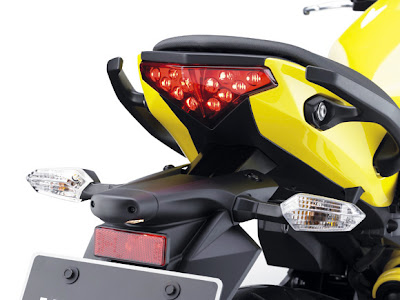
Lighter handling
Frame rigidity balance double-pipe and swingarm contributes to the package handling lighter, easier. Rigid-mounted engine was a member, contribute to stress the ideal frame rigidity balance.
New design Swingarm the dual pipeline makes use of the D-section tube (right tube) for an optimal rigidity. Revised suspension has a long stroke front and rear, offering sporty handling and refined comfort. Rear shock length and stroke 2 mm longer; the front fork is 15 mm longer stroke length 5 mm to match hindsight. Turn the spring Stroke lower levels. Damping has been revised accordingly.
The fuel tank is higher
The fuel tank is 20 mm higher, helped to concentrate the ER-6n visual mass in front of the bike. The back of the tank slopes back in a straight line to the Chair.
Other torque in the range of every dayUnder-Engine muffler with more volume and revision of internal construction provides increased torque on the range on a daily basis under 7,000 rpm. Improvements to facilitate controls on low rpm and contributes to improving the enjoyment of 6n-ER.

2012 Kawasaki ER6nSpecifications
ENGINEType 4-stroke, Parallel Twin
Displacement 649cc
Bore and Stroke 83.0 x 60.0 mm
Cooling Liquid
Compression Ratio 10.8:1
Valve System DOHC, 8 valves
Fuel System Digital fuel injection with two 38 mm Keihin throttle bodies
Ignition Digital
Lubrication Forced lubrication (semi-dry sump)
DRIVETRAIN
Transmission 6-speed, with positive neutral finder
Final Drive Sealed Chain
Primary Reduction Ratio 2.095 (88/42)
Gear Ratio: 1st 2.438 (39/16)
Gear Ratio: 2nd 1.714 (36/21)
Gear Ratio: 3rd 1.333 (32/24)
Gear Ratio: 4th 1.111 (30/27)
Gear Ratio: 5th 0.966 (28/29)
Gear Ratio: 6th 0.852 (23/27)
Final Reduction Ratio 3.067 (46/15)
Clutch Wet multi-disc, manual

FRAME
Type Perimeter, high-tensile steel
Wheel Travel: Front 125 mm (4.9 in.)
Tire: Front 120/70ZR17M/C (58W)
Wheel Travel: Rear 130 mm (5.1 in.)
Tire: Rear 160/60ZR17M/C (69W)
Caster (Rake) 25º
Trail 110 mm (4.3 in.)
Steering Angle (Left/Right) 35º / 35º
SUSPENSION
Suspension, Front 41 mm telescopic fork
Suspension, Rear Offset laydown single-shock with adjustable preload
BRAKES
Front: Type Dual semi-floating 300 mm petal discs
Front: Calipers Dual piston
Rear: Type Single 220 mm petal disc
Rear: Caliper Single-piston
DIMENSIONS
Overall Length 2,110 mm (83.1 in.)
Overall Width 770 mm (30.3 in.)
Overall Height 1,110 mm (43.7 in.)
Wheelbase 1,410 mm (55.5 in.)
Ground Clearance 130 mm (5.1 in.)
Seat Height 805 mm (31.7 in.)
Curb Mass** 204 kg (449.7 lbs.)
Fuel Capacity 16 litres (3.5 gal.)
Fuel Consumption N/A
PERFORMANCE
Maximum Power‡ 53 kW {72.1 PS} / 8,500 rpm
Maximum Torque‡ 64 N.m {6.5 kgf.m} / 7,000 rpm
DETAILS
MSRP* N/A
Colours Pearl Shining Yellow, Metallic Spark Black
Warranty 12 months warranty
ADDITIONAL COST OPTIONS
2012 Kawasaki ER6n Photos and Pictures


Thanks For Reading "2012 Kawasaki ER6n Review, Pictures and Specs", See Also "Kawasaki Ninja 250R Prices and Specifications".
Subscribe to:
Posts (Atom)